What do you know about fish wellbeing? Our University of Graz' researchers know quite a lot!
You can now do a deep dive (pun intended) into molecular ecologist Tamara Schenekar's new preprint, published with three international collagues, on temperature related variation in methylated environmental RNA in fish.
We've recently given one of the RCC micro-grants to Tamara, and she has reported back on its impact!
What was your funded activity?
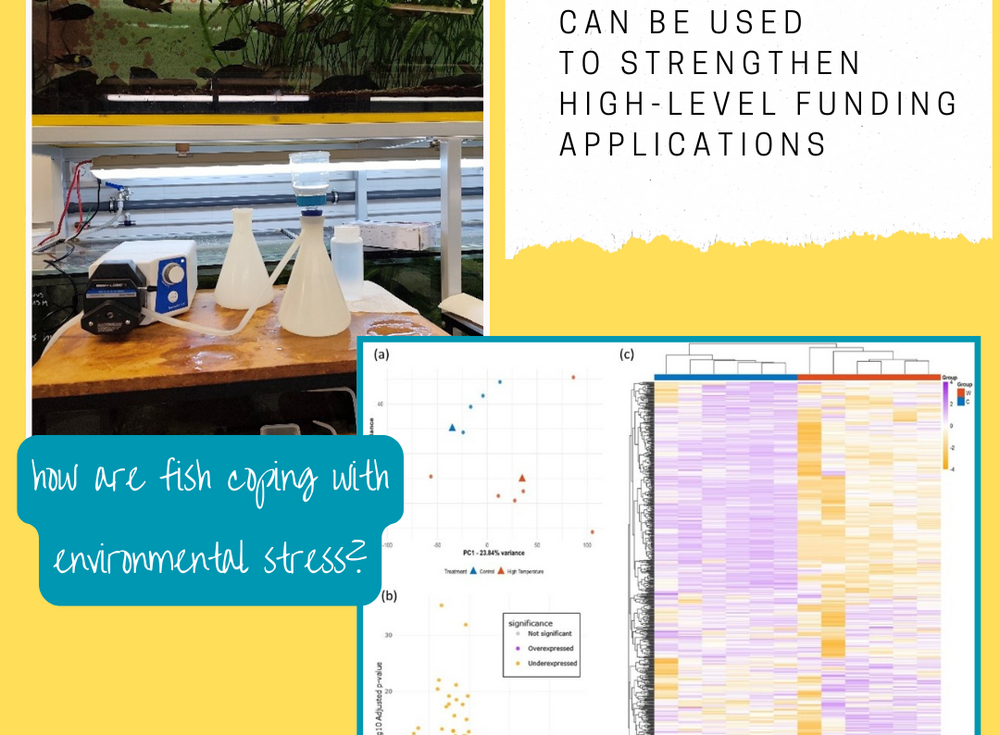
We ran a proof-of-concept experiment to explore a new, non-invasive way to check how fish are coping with environmental stress - using traces of genetic material they naturally release into the water (environmental RNA, or eRNA). Instead of catching or handling fish, we sampled their tank water in our Institute of Biology aquarium facilities to see whether the eRNA can reveal if fish experience heat stress.
We kept one group of fish at their preferred temperature and another group slightly warmer, then compared the signals we detected in their water after seven days. This approach aims to make aquatic monitoring gentler, faster, and more informative for conservation and management.
What impact did the activity have on your research and career development?
It significantly strengthened my European Research Council (ERC) Synergy Grant application by providing robust preliminary data. The results were better than we expected, giving us confidence that eRNA can capture meaningful stress information without disturbing animals. We were able to publish a preprint based on these findings (see link above)!
While we received co-financing from the Vice-Rectorate for Research, we needed further support for the sequencing analyses. The RCC grant filled that gap and enabled us to turn a promising idea into compelling evidence - exactly the kind of boost that makes high-impact grant applications possible.
What was something unexpected that happened during your activity?
Watching the story unfold from the clear tank water was surprisingly thrilling, seeing how “invisible” traces can speak volumes about fish well-being. And a personal highlight: realizing that a simple, non-invasive water sample can open doors to smarter conservation, without a single net or stressful handling.
Thanks a lot, Tamara Schenekar, for sharing that story with us, and the link to the fascinating preprint! Tamara's website can be found here.
Interview: 6.2.2026, Johanna Stadlbauer