Begin of page section:
Page sections:

  • Go to contents (Accesskey 1)
  • Go to position marker (Accesskey 2)
  • Go to main navigation (Accesskey 3)
  • Go to sub navigation (Accesskey 4)
  • Go to additional information (Accesskey 5)
  • Go to page settings (user/language) (Accesskey 8)
  • Go to search (Accesskey 9)

End of this page section. Go to overview of page sections

Begin of page section:
Page settings:

English en
Deutsch de
Search
Login

End of this page section. Go to overview of page sections

Begin of page section:
Search:

Search for details about Uni Graz
Close

End of this page section. Go to overview of page sections


Search

Begin of page section:
Main navigation:

Page navigation:

  • University

    University
    • About the University
    • Organisation
    • Faculties
    • Library
    • Working at University of Graz
    • Campus
    Developing solutions for the world of tomorrow - that is our mission. Our students and our researchers take on the great challenges of society and carry the knowledge out.
  • Research Profile

    Research Profile
    • Our Expertise
    • Research Questions
    • Research Portal
    • Promoting Research
    • Research Transfer
    • Ethics in Research
    Scientific excellence and the courage to break new ground. Research at the University of Graz creates the foundations for making the future worth living.
  • Studies

    Studies
    • Prospective Students
    • Students
    • Welcome Weeks for First Year Students
  • Community

    Community
    • International
    • Location
    • Research and Business
    • Alumni
    The University of Graz is a hub for international research and brings together scientists and business experts. Moreover, it fosters the exchange and cooperation in study and teaching.
  • Spotlight
Topics
  • Sustainable University
  • Researchers answer
  • Work for us
Close menu

End of this page section. Go to overview of page sections

Begin of page section:
You are here:

University of Graz Information and Service for PostDocs News Networking, archival research, and meeting one’s readers
  • Blog
  • Tips and Tricks
  • Funding
  • Offers for PostDocs
  • News
  • Events

End of this page section. Go to overview of page sections

Thursday, 26 February 2026

Networking, archival research, and meeting one’s readers

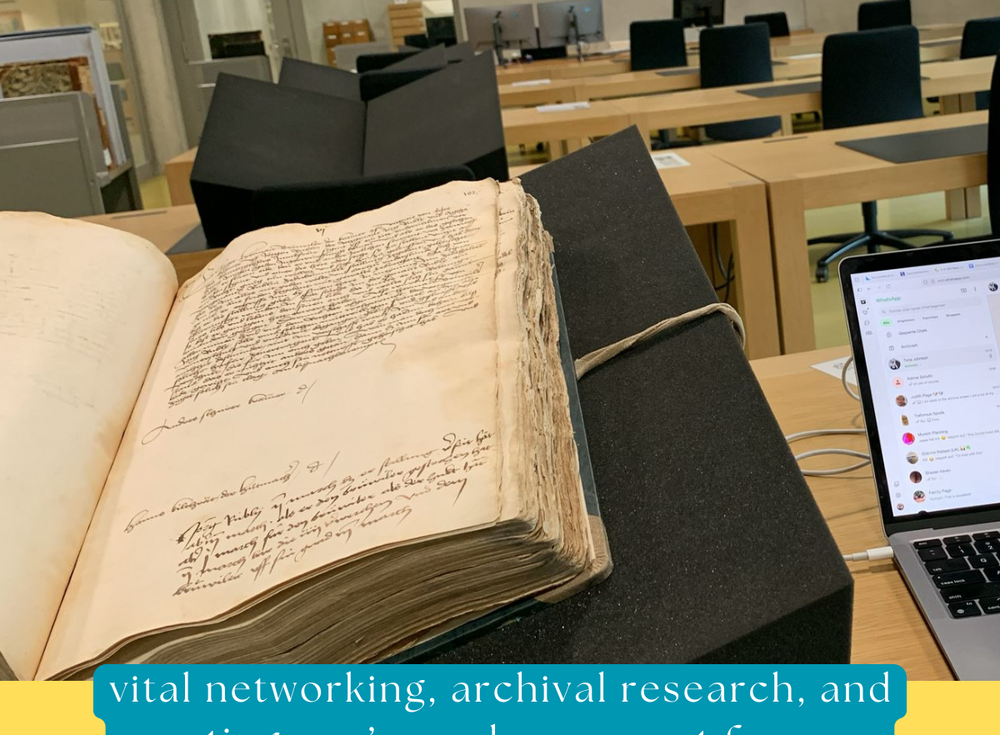
Archivaufnahme Page, Schweiz

Read Jamie Page's travelogue from Switzerland

Have you had chance encounters with readers of your academic texts? How did it make you feel? Historian and masculinity researcher Jamie Page had this pleasure, and told us all about how he used his RCC mobility grant.


1) What was the funding used for?

The RCC gave generous funding for me to spend a week in Switzerland to present some early results from my Habilitation project, to do some vital networking, and to carry out archival research for the project’s next stages. The first stop was the University of Lausanne, where I delivered a paper on ‘Masculinity and Historical Writing in the Old Swiss Confederation’ to the late medieval research seminar. 

This was the first time I had presented my work on Swiss national mythologies to a Swiss audience, who as children had grown up with stories of William Tell, and I was glad to be received so warmly (coming no less from a university in Austria - hereditary enemies of the Swiss!). 

I then crossed the Röstigraben and spent a wonderful few days in Zurich, meeting contacts at the university and returning to the Staatsarchiv Zürich, which I know well from my doctoral studies. For anybody interested in late medieval cities (especially crime!) the archive is a dreamland.

2) Why did it matter?

The trip was a vital early step in my new project. The chance to network and receive direct feedback from those close to the sources has helped me to plan the next phases and sharpen my thinking on key issues. The trip also underscored the vital importance of personal contacts and physical encounters with sources. 

Digital technology has brought us much in terms of networking and access to material, but so much of historical research still depends on the idiosyncratic and the unexpected. 

3) What else do you remember about the trip? 
 

When I first came to Zurich I was a timid second-year PhD student, just trying to find my way into archival work. 

When I returned to the Staatsarchiv this time, the archivist recognised me after having read the book I wrote about Zurich based on that first visit - it was an emotional moment which made all the uncertainty and hard work seem worth it! 


Congratulations on this, and thanks for sending this in, Jamie!

→ Find out more about the RCC funding schemes
→ Get to know Jamie Page in a podcast: “Gone Medieval”


Picture credit: Jamie Page, Interview: Johanna Stadlbauer, RCC, 26.2.2026

Related news

Did you know we provide daily updates on LinkedIn?

Follow our page which is now three years of age!

Enabling students to be confident researchers and competent academic writers

Three questions for Alexandra Roth and Alexander Doric of WAS

How a PostDoc Grant can strenghten your high-level funding applications

Read a report by Tamara Schenekar on fish wellbeing research

Internal call open for €10000 mobility grants for high potentials

Apply for Visiting Awards for High Potentials by Mar 1 2026

Begin of page section:
Additional information:

University of Graz
Universitaetsplatz 3
8010 Graz
Austria
  • Contact
  • Web Editors
  • Moodle
  • UNIGRAZonline
  • Imprint
  • Data Protection Declaration
  • Accessibility Declaration
Weatherstation
Uni Graz

End of this page section. Go to overview of page sections

End of this page section. Go to overview of page sections

Begin of page section:

End of this page section. Go to overview of page sections